
There’s a moment in To Kill a Mockingbird that’s always stayed with me. Scout, the narrator, describes sitting on her father Atticus’s lap while he read the newspaper—his finger trailing under the words as he read aloud. She didn’t know when the letters became words for her, but she knew how—his finger guided her path. That passage became a blueprint for me long before I became a mother. As a teacher, I used that same finger-pointing strategy to help young readers connect sounds to symbols, tracking each word with intention to support fluency and comprehension.
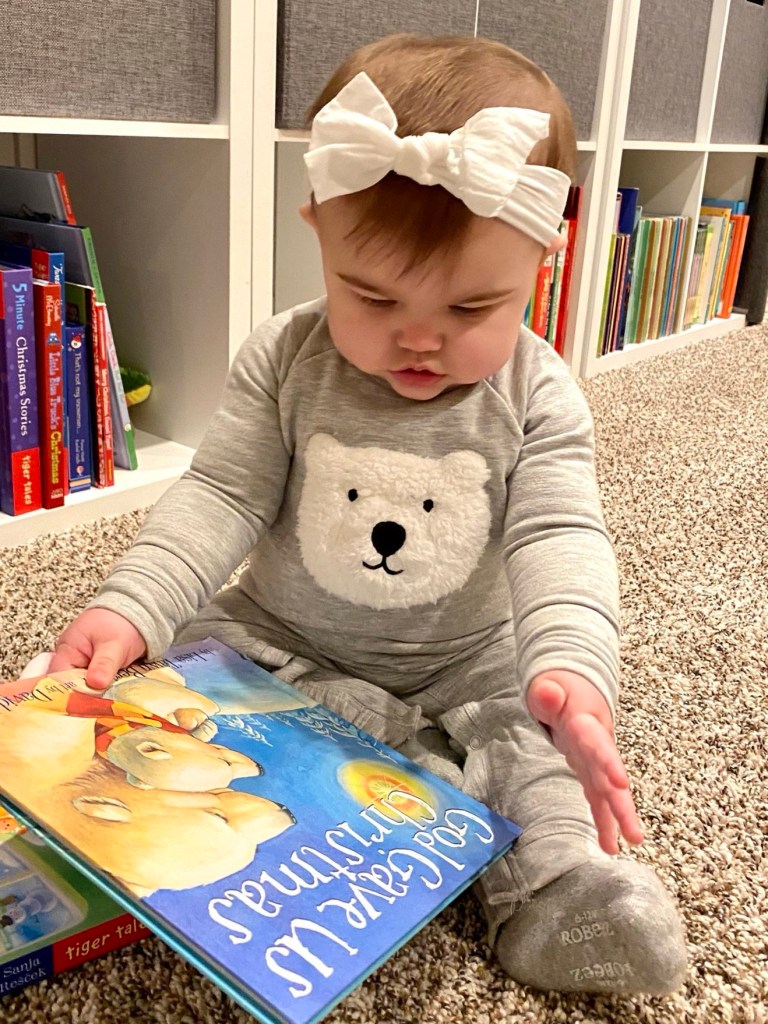


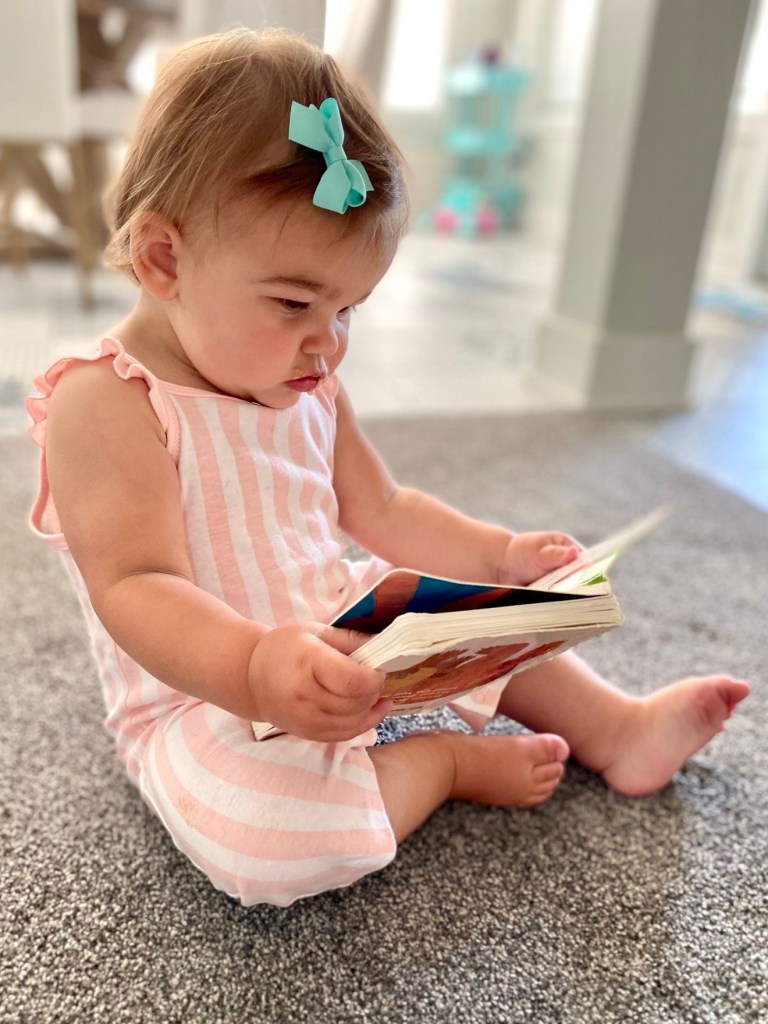


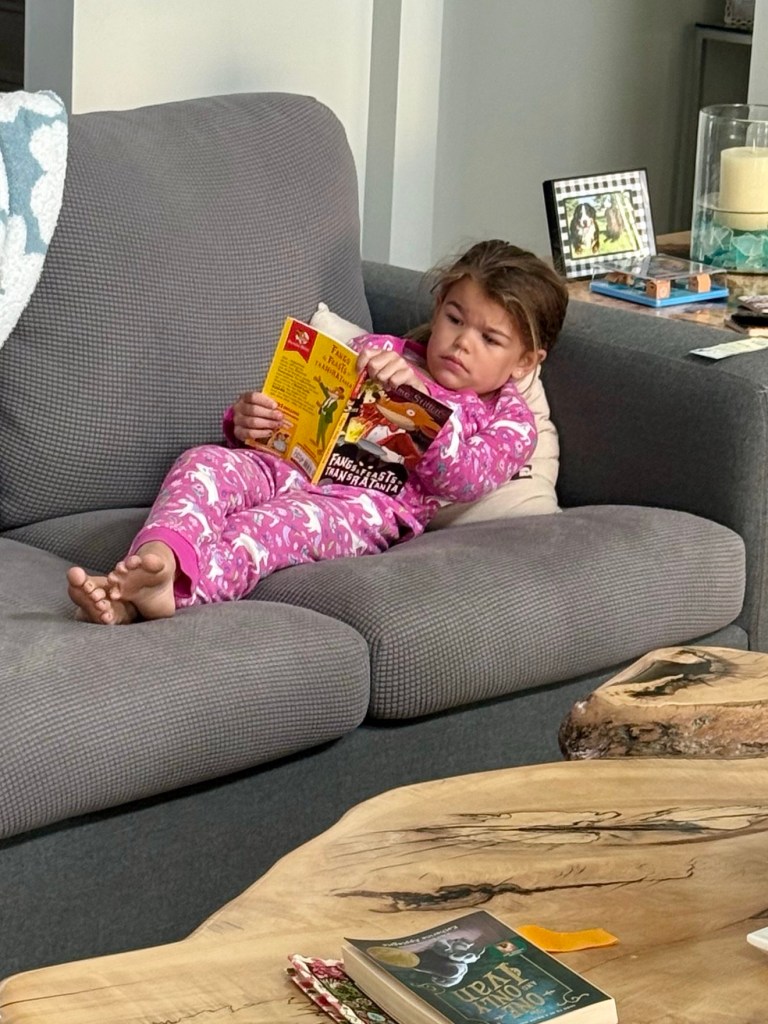
When Lucy was born, I brought that philosophy into our home. From the time she could hold her head up, I read to her constantly. Reading wasn’t just a routine—it was part of a gentle structure I called “activity time,” and books were at the heart of it. Even when she was too little to recognize letters, I would point to the words as I read. I believed her mind could take in far more than I could ever imagine, and I wasn’t going to limit her based on what I thought she couldn’t do. Pointing to the words gave her the very first stepping stone to understanding how a book works.
Books were everywhere. We didn’t visit the library for just one or two titles—we filled my tote basket until it strained at the seams. Twenty-two to twenty-four books per visit was our norm because that’s all we could stuff in the tote. We read outside in the sunshine, cuddled on the couch, and on car rides—books always took the place of screens.
This constant exposure to language was transformative. Lucy’s vocabulary blossomed, her communication skills soared, and her comprehension skills left us speechless. I didn’t quiz her—I just listened. The way she retold stories to her dad was so detailed and accurate, it was like hearing the book again.
Around age two and a half, I made a shift. Instead of picture books at bedtime, I started reading novels—stories rich in language and moral character. We read classic literature and selections from The Good and the Beautiful book list. I wanted Lucy to be immersed in beauty, both through vocabulary and values.
It was astounding to watch her imagination light up. She could see the scenes in her mind, and she learned to focus. I told her: if you don’t focus, you miss the story. And she didn’t want to miss a thing.
By the time Lucy turned three, she could read her own early readers—those precious “My First Reader” books. We’d all beam with pride watching her hop onto the couch, cross her little legs, and sound out each word with determination and joy.
But one moment, in particular, took my breath away. One evening when Lucy was four, I was reading one of our nighttime novels aloud, cuddling her in one arm and holding the book in the other. Because of the way we were snuggled in, I wasn’t able to point to the words as I usually did. As a dyslexic reader myself, I occasionally mix things up. That night I read, “…said Timothy,” when suddenly Lucy stopped me. “Mom,” she said gently, “it says ‘Timothy said,’ not ‘said Timothy.’” I looked down, and she was absolutely right.
She wasn’t just listening—she was reading along silently, word for word, catching even the smallest detail.
That’s when I realized: she had cracked the code completely.
One of the key things I want to encourage other parents to do is to not shy away from emotionally rich books. Some stories we read have hard, even sad moments—and I’ve never been ashamed to cry in front of my daughter. Today, when Lucy sees me cry during a book (we’re currently reading The One and Only series by Katherine Applegate—highly recommend a tissue box!), she doesn’t pull away. She grabs a Kleenex, hands it to me, and snuggles in closer. I’ve always told her that if a book speaks to your heart so deeply that it makes tears come, that’s nothing to be ashamed of. It just means you have a very beautiful heart.
One of my favorite memories was from Lucy’s homeschool connection program—a Christian school she attends one day a week while we homeschool the rest. At Christmastime, her teacher snapped a photo and sent it to me: Lucy, in her sparkle boots and her gingerbread sweater, sitting tall and proud in front of the classroom, reading one of her favorite Christmas stories aloud to the entire class—for show and tell! That image was such a full-circle moment, a glimpse of everything her reading journey had led to—confidence, clarity, and a heart full of light.
I’ll be posting a list of suggested read-aloud novels that we’ve loved in the Raising Light Resources section soon, so stay tuned if you’re looking for stories that uplift, inspire, and spark the imagination.
In the meantime, the greatest piece of advice I can offer is this:
Read to your child. Early. Often. With feeling.
Point to the words.
Invite them to follow along.
Hold their sweet hand in yours and guide their little finger, even if they don’t yet know what it means.
Their heart will.
And one day, when you least expect it, they just might read the story back to you.

 Raising Light