
Last night, as the sun dipped low over an outdoor dinner with my family, something unexpected and quietly beautiful happened.

Lucy spotted a clock tower across the street and asked what time it was. We’ve been working on telling time lately, especially with analog clocks—something I’ve been intentional about. Her birthday gift this year included a little analog wristwatch, not digital, because I want her to truly learn time—not just read it.
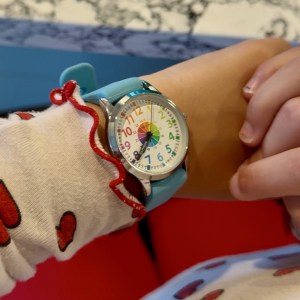
She squinted at the tower and studied the hands.
“Well,” she said, “the hour hand is between the six and the seven, so it’s still six.”
“That’s right,” I smiled. “And what’s the minute hand on?”
“The 10,” she answered confidently. “So it’s 6:50!”
“Yes, Lucy! Or another way to say it is ‘ten to seven’—because in 10 minutes, it’ll be seven o’clock.”
And then, the gentleman sitting at the next table turned to us.
“Thank you for teaching her that,” he said. “You don’t know how many kids these days can’t read an analog clock. They just don’t know anymore. So really, thank you.”
He went on to say how well-behaved both of our children were—how nice it was to see a family actually together at a restaurant, no phones in hand, kids staying seated and engaged.

It was one of those rare, unsolicited affirmations from a stranger that hits in the deepest part of your parenting heart. Because let’s be honest: teaching life skills takes time, patience, and consistency. And sometimes, in the thick of it, you wonder if it’s all even registering.
But there it was—a moment of clarity and encouragement, gift-wrapped in kindness from someone we’ll likely never see again.
And yet, the joy of that moment was laced with something else too: a quiet sadness. Because what he said was true. We’ve drifted so far as a society from teaching kids simple skills, basic manners, and the value of presence. Technology has given us so much, but it’s also taken more than we care to admit—our attention, our family “face time,” and in many cases, our children’s curiosity and independence.
We live in a world where knowing how to read a clock is becoming a lost art. Where dinner conversations are replaced by screen swipes. Where a compliment like his feels extraordinary—when it really should be the norm.
Last night reminded me of something important: that the time we spend teaching our kids these basic, beautiful life skills matters. The time we spend looking into their eyes instead of our screens matters. And the way we model presence, respect, and engagement might just be what the world is so desperately needing more of.
So thank you, kind stranger, for reminding me that even the simplest lessons are worth the time. And thank you, Lucy, for reminding me that learning how to read the minutes… sometimes gives us the most meaningful moments.

 Raising Light